
On this page
- The three October changes, at a glance
- 1. A 24-month tax-group exclusion — but not for every related company
- 2. More cloud-storage flexibility does not remove recordkeeping
- 3. The two-business-day system-failure notice is repealed
- What has not changed: a PDF is still not an eInvoice
- UAE eInvoicing deadlines businesses should check
- Where the billing system and the ASP fit
- Example: one retailer, two very different sales paths
- A seven-step billing-software readiness checklist
- What UVs Digital Hub can help review
On 19 October 2026, the UAE Ministry of Finance announced Ministerial Decision No. 197 of 2026, changing three parts of the country's electronic invoicing framework: a temporary exclusion for transactions within the same tax group, more flexibility over where invoice data is stored, and the removal of a specific system-failure notification requirement. The decision took effect on 1 October 2026. The tax-group exclusion starts separately, on 1 January 2027. Source: Ministry of Finance.
The October amendment changes three specific eInvoicing rules; it does not cancel the UAE rollout. The decision took effect on 1 October 2026, while the 24-month intra-tax-group exclusion starts on 1 January 2027. Businesses still need to assess structured invoicing, record retention and ASP readiness.

For business owners, finance teams and software managers, this is not a reason to stop an eInvoicing project. It is a reason to review the implementation plan while retaining the parts that still matter: structured invoice data, correct transaction classification, an appropriate Accredited Service Provider (ASP), and dependable records.
The three October changes, at a glance
| Area | What changed | What to review |
|---|---|---|
| Tax-group transactions | Business transactions between persons in the same tax group are treated as excluded transactions for 24 months from 1 January 2027. | Confirm tax-group status and identify the transactions affected. Do not exempt outside-group sales. |
| Invoice-data storage | The previous requirement to store electronic invoice and credit-note data within the UAE has been removed. | Revisit hosting plans, but preserve required retention, retrieval and FTA access. |
| System failures | The rule requiring notification to the FTA within two business days of a defined system failure has been repealed. | Update escalation procedures without removing error monitoring, recovery or audit trails. |
These three highlighted changes come from the Ministry of Finance's 19 October announcement, which describes amendments to Ministerial Decision No. 243 of 2025. The practical actions above are implementation suggestions, not additional legal requirements.
2. More cloud-storage flexibility does not remove recordkeeping
The amended Article 11 removes the previous requirement that electronic invoices, electronic credit notes and associated data be stored inside the UAE. It does not remove the obligation to retain those records for the period prescribed by the Tax Procedures Law or to provide them to the Federal Tax Authority (FTA) on request. Ministry of Finance.
A business using a cloud-based ERP should therefore ask operational questions before relocating or consolidating its archive: Who controls access? How quickly can invoice records be retrieved? Do backups contain the associated data needed to explain a correction or credit note? What happens if the service or integration is unavailable?
Practical interpretation: The removal of a UAE-only storage rule creates flexibility over architecture; it is not a statement that every storage, security or cross-border arrangement is automatically suitable. Other applicable contractual or legal requirements still need checking.
3. The two-business-day system-failure notice is repealed
The amendment repeals Article 12 of the earlier decision and removes the associated definition of “System Failure”, including the obligation to notify the FTA of such a failure within two business days. Ministry of Finance.
That change should not be interpreted as permission to ignore failed submissions. In practice, a billing integration still needs to show which transactions were accepted, rejected, retried or remain unresolved. A failed connection without a visible reconciliation process can create finance-team problems even when a particular notification obligation no longer applies.
Keep operational controls: an exception queue, retry safeguards against duplicate invoices, documented ownership of errors, recoverable records, and periodic reconciliation between the billing system and the ASP.
What has not changed: a PDF is still not an eInvoice
The FTA defines an eInvoice as structured invoice data exchanged electronically between supplier and buyer and reported electronically to the FTA. An emailed PDF, scanned receipt, Word file or image does not become an eInvoice simply because it is digital. FTA eInvoicing overview.
That matters for existing UAE billing and POS software. A system may produce a well-designed VAT invoice, calculate the correct tax and export a PDF, but still require additional data mapping, transaction routing and an ASP connection for the applicable eInvoicing process.
The announced programme primarily addresses business-to-business (B2B) and business-to-government (B2G) transactions, subject to stated exclusions. Do not assume that every retail consumer receipt should follow the identical workflow. Ask your tax adviser to confirm the scope for each transaction type. MoF framework announcement.
UAE eInvoicing deadlines businesses should check
| Who is in the implementation phase? | ASP appointment deadline | eInvoicing implementation deadline |
|---|---|---|
| In-scope businesses with annual revenue of AED 50 million or more | 30 October 2026 | 1 January 2027 |
| In-scope businesses with annual revenue below AED 50 million | 31 March 2027 | 1 July 2027 |
| In-scope government entities | 31 March 2027 | 1 October 2027 |
The first two rows are confirmed in the FTA's 29 September 2026 update. The government-entity phase is described in the Ministry of Finance's rollout announcement. Check official updates and confirm your own classification; no software vendor can determine scope from revenue alone without reviewing the applicable rules.
For the first phase, 30 October 2026 is close. If your business is in scope and has not appointed an ASP, confirm the next steps immediately with your responsible team and a qualified adviser. The October amendment did not announce a general postponement of implementation.
Where the billing system and the ASP fit
A practical implementation usually involves several systems with different responsibilities. Your billing, POS or ERP solution creates the business transaction. The integration prepares the necessary structured data. An Accredited Service Provider performs the applicable service-provider functions under the UAE framework. The business still needs to reconcile what was issued with what was processed.
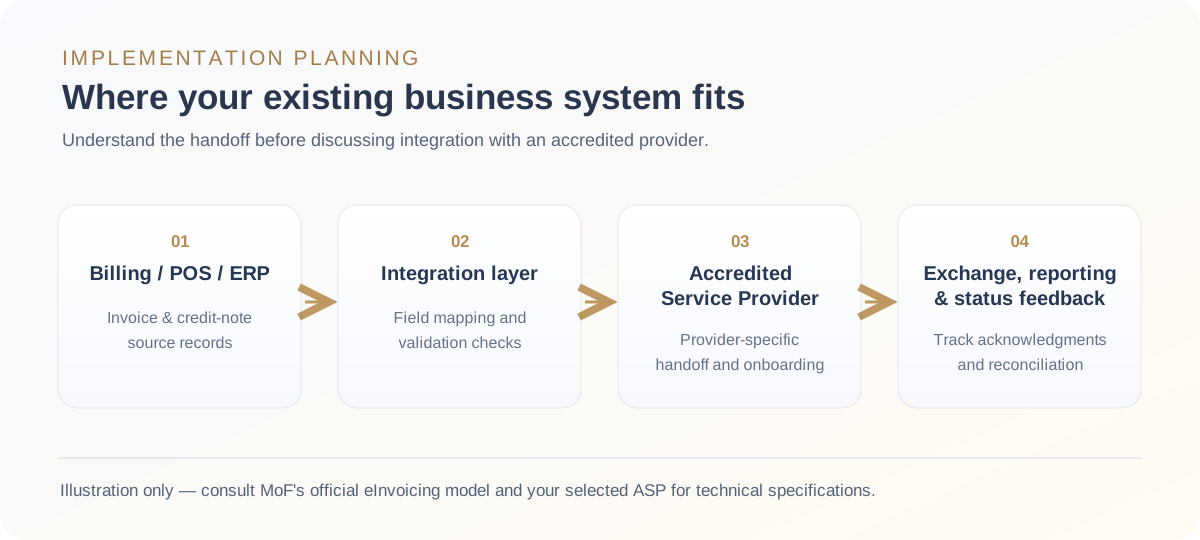
Software-to-ASP handoff: four steps
Prepare source invoice and credit-note records.
Map required fields and validate data before sending.
Use the selected accredited provider for the applicable exchange and reporting functions.
Keep acknowledgements, error status and financial records aligned.
Illustrative planning sequence only. Refer to the Ministry of Finance for the official UAE eInvoicing technical architecture.
Do not assume that an existing billing vendor is an Accredited Service Provider. Verify the provider's status against the Ministry's published ASP list, which the Ministry updates periodically. A software development company can help with requirements, integration and testing without itself claiming government accreditation.
Example: one retailer, two very different sales paths
Imagine a UAE retailer with counter sales to walk-in consumers and monthly invoices to commercial customers. Its POS supports VAT, payment collection, stock deduction and a daily sales report. The finance team now needs to determine which invoice types enter the eInvoicing process, which should remain on the existing consumer workflow, and how cancellations and credit notes are handled.
A sensible first test is not “Can we export every receipt as XML?” It is to identify representative sales, credit notes and corrections, confirm their required treatment, then test the data journey from the transaction through to acknowledgement and reconciliation. This avoids making a small till operation unnecessarily complex while missing the more important B2B flow.
A seven-step billing-software readiness checklist
- Confirm scope with your finance team. List legal entities, VAT/tax-group arrangements, transaction categories, annual revenue and relevant implementation phases. Have an adviser validate the conclusions.
- Map the invoice journey. Trace sales invoices, credit notes, cancellations and corrections from entry to reporting. Include branch, customer and tax fields where applicable.
- Inspect existing master data. Check customer details, tax identifiers, product/service descriptions, invoice numbers, dates and the completeness of source records.
- Review your hosting and archive. Record retention periods, locations, backups, access rights, retrieval procedures and the ability to respond to an FTA request.
- Confirm the ASP arrangement. Check the Ministry's current accredited-provider listing, integration method, responsibility split, charges, support and onboarding steps.
- Test exception cases. Try a missing field, failed transmission, duplicate request, corrected invoice and service outage. Check status, recovery and reconciliation — not only the happy path.
- Document acceptance and ownership. Agree who signs off tax rules, who maintains the software, who monitors submission errors and what staff will do when a transaction fails.
Five questions worth sending to your software team: Which transaction types are in scope? Which mandatory fields are missing? Where will failed invoices be visible? How will records be retrieved later? What must be tested with the selected ASP before go-live?
What UVs Digital Hub can help review
UVs Digital Hub works on UAE billing, POS and business-software workflows, including billing, stock, customer records, operational reporting and custom integrations. For an eInvoicing project, a sensible starting point is to map the existing system, identify data gaps, document the ASP hand-off and define an integration test plan.
We do not present UVs Digital Hub as an FTA-approved eInvoicing provider or as a substitute for qualified tax advice. Accreditation, regulatory scope and tax interpretations must be confirmed separately.
Planning a billing or POS system review? Share your requirements with UVs Digital Hub. Include your business type, software name, number of branches, invoice volume, transaction types and any ASP already selected.
Need to map your invoicing, POS or ERP workflows? We can help scope software changes, data mapping, integration testing and reporting requirements. Accreditation and tax interpretation remain the responsibility of the relevant accredited provider and qualified advisers.
Frequently asked questions
Does the October 2026 amendment postpone eInvoicing for all UAE businesses?
No. The amendment introduces targeted changes; it does not announce a general delay to the phased implementation deadlines. Businesses should use their applicable phase and check the latest official announcements.
Are all transactions between companies with the same owner excluded for two years?
No. The announced temporary treatment concerns transactions between members of the same tax group from 1 January 2027 for 24 months. Common ownership alone should not be used as the software rule.
Can a business now store eInvoice records outside the UAE?
The specific UAE-only storage requirement under amended Article 11 has been removed. Required retention and access for the FTA remain. Validate other applicable requirements before choosing a storage arrangement.
Does a VAT-compliant PDF invoice satisfy the new electronic-invoicing format?
Not by itself. The FTA distinguishes structured electronic invoice data from PDFs and other unstructured files. A PDF can still be useful for the customer or internal records, but it is not a replacement for the prescribed eInvoice exchange where the system applies.
Is system-failure logging still useful after the notification rule was repealed?
Yes. The specific two-business-day notification obligation was removed, but a reliable software process still needs to detect errors, manage retries, prevent duplicates and reconcile transactions. Those are implementation recommendations, not a claim that the repealed notice requirement remains in force.
Official sources and further reading
- UAE Ministry of Finance — Ministerial Decision No. 197 of 2026 announcement (19 October 2026)
- Federal Tax Authority — eInvoicing implementation dates and ASP appointment guidance (29 September 2026)
- Ministry of Finance — UAE eInvoicing official programme, guidance and legislation
- Federal Tax Authority — What is an eInvoice?
- Ministry of Finance — Published list of eInvoicing Accredited Service Providers
- Ministry of Finance — Rollout scope and timelines (29 September 2025)
Editorial note: Verified against official MoF and FTA pages on 20 October 2026. This article provides general operational and software-planning information, not legal or tax advice. Confirm regulatory interpretation with an appropriately qualified professional and check for later official updates before implementation.